

University of Waterloo
Nearly two centuries after one of the Arctic’s most enduring mysteries, scientists say new DNA evidence is helping reconstruct what happened to members of the doomed Franklin Expedition, whose disappearance has haunted historians since the mid 19th century.
The expedition, led by British naval officer John Franklin, set sail in 1845 aboard HMS Erebus and HMS Terror in search of the Northwest Passage a sea route linking the Atlantic and Pacific oceans. All 129 crew members vanished after their ships became trapped in Arctic ice near what is now northern Canada.
For decades, fragments of evidence abandoned camps, scattered bones and Inuit oral histories hinted at starvation, disease and desperation. Now, researchers say advances in genetic testing are allowing them to identify individual sailors for the first time.
Identifying the Lost Sailors
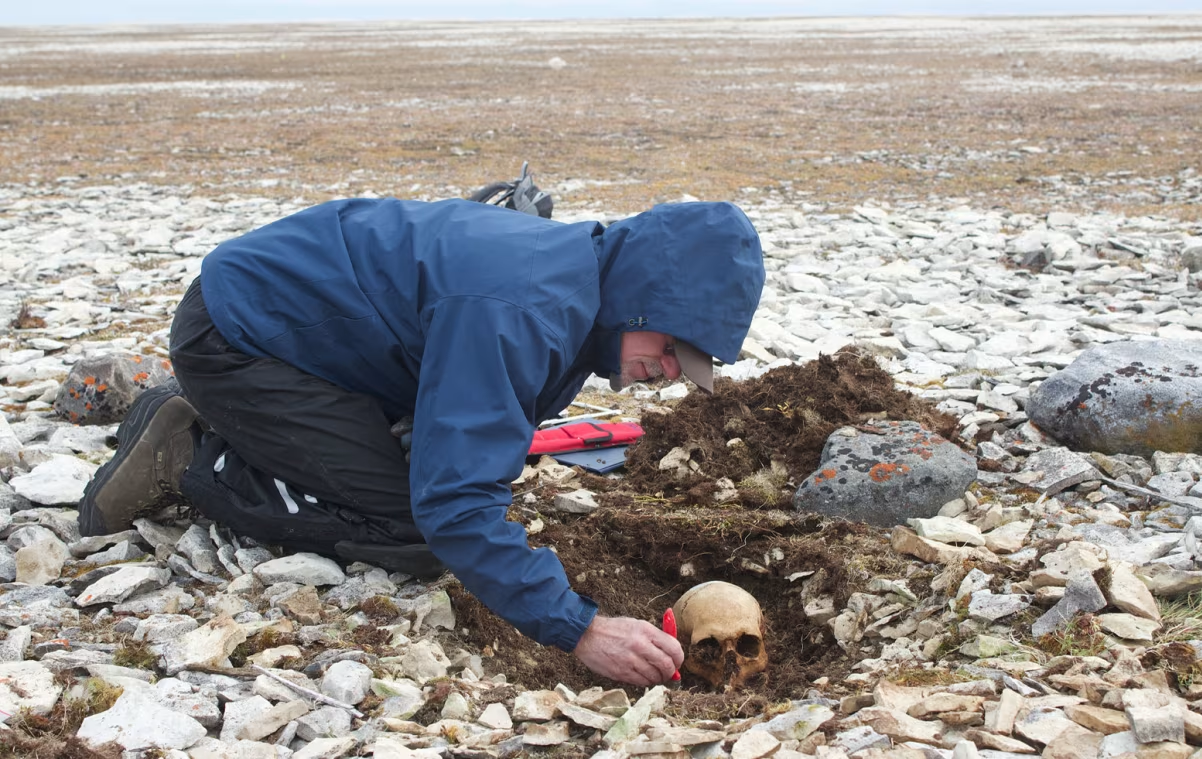
Scientists analyzed DNA extracted from human remains recovered on King William Island, comparing genetic material with living descendants of the crew. According to researchers involved in the study, several remains previously anonymous can now be linked to specific expedition members.
“This allows us to restore identity to people who effectively disappeared from history,” one researcher involved in the project said, noting that earlier investigations relied mainly on artifacts and written records rather than biological evidence.
The findings also help clarify movement patterns of the stranded sailors after abandoning their ships in 1848, when the expedition’s surviving members attempted a desperate southward trek across the frozen landscape.
Evidence Supports Grim Historical Accounts
Accounts recorded by Inuit witnesses long suggested that some sailors resorted to extreme survival measures as food supplies ran out. Earlier forensic studies had already pointed to starvation and possible cannibalism among the crew.
The new genetic work does not dramatically rewrite that narrative, but strengthens it by confirming which individuals were present at particular sites along the escape route.
Researchers said communication between surviving groups likely broke down as conditions worsened something reflected in the scattered locations where remains have been discovered over decades of searches.
“Details remain incomplete,” one Arctic historian explained, “but we are now moving from legend toward verifiable human stories.”
Science Meets Oral History
For years, Western explorers discounted Inuit testimony describing starving European sailors moving across the ice. Modern historians increasingly view those accounts as essential historical evidence.
The DNA study reinforces that shift, showing that scientific analysis and Indigenous knowledge often converge rather than conflict.
A Canadian archaeologist involved in northern excavations said Inuit communities have played a central role in guiding modern searches. “Without local knowledge, many discoveries simply would not have happened,” the researcher said.
A Mystery That Still Isn’t Fully Solved
Despite major discoveries including the wrecks of HMS Erebus in 2014 and HMS Terror in 2016 key questions remain unanswered. Why the ships were abandoned when they still contained supplies, how leadership decisions unfolded, and how long the final survivors endured are still debated among historians.
Researchers caution that DNA evidence provides only part of the picture. Environmental conditions, illness and psychological strain likely combined to shape the expedition’s tragic end.
As more genetic comparisons are conducted, scientists hope additional identities will emerge, gradually transforming one of exploration history’s greatest mysteries into a more personal account of individual lives lost in the Arctic.
Nearly 180 years after the ships disappeared into the ice, the Franklin expedition is no longer only a story about exploration and empire. It is becoming, piece by piece, a record of real people sailors whose names are finally returning after generations of silence.

Promise Idoko is Junior Reporter working with moderncrux He covers global politics and international affairs. Based in Nigeria,