

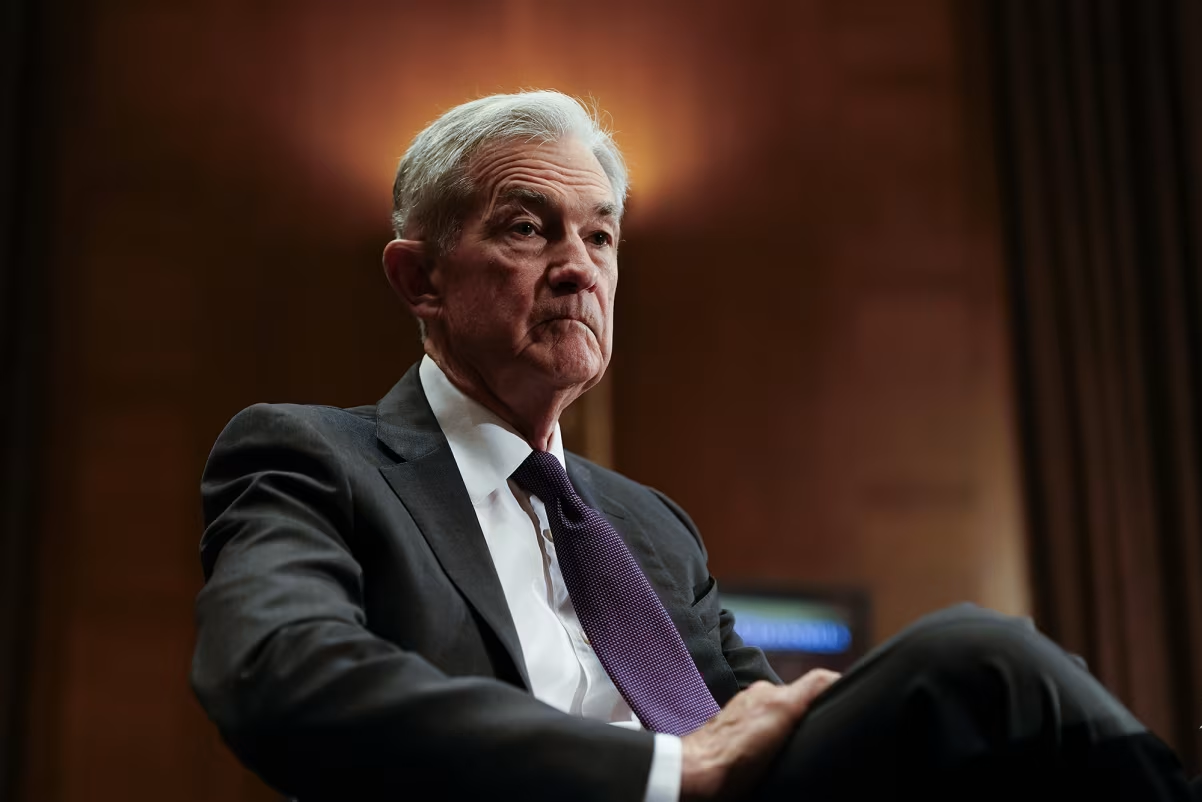
Kent Nishimura/Getty Images/File
The future of the U.S. Federal Reserve leadership has returned to the spotlight after renewed political pressure surrounding Jerome Powell, whose tenure as chair is approaching a critical turning point amid tensions with President Donald Trump.
Powell’s current term as Federal Reserve chair is scheduled to conclude in May 2026, a date that has increasingly become central to Washington’s economic and political debate. While there has been no formal announcement confirming an early exit, speculation about leadership change has intensified as the White House weighs its next move on monetary policy leadership.
The discussion is unfolding against a broader backdrop: rising disagreements over interest rate strategy, economic growth concerns, and the independence of America’s central bank.
Political Pressure Meets Central Bank Independence
Tensions between Trump and Powell are not new. The president has repeatedly criticized the Federal Reserve’s reluctance to rapidly cut interest rates, arguing that tighter monetary policy risks slowing economic momentum.
Powell, however, has maintained that Federal Reserve decisions must remain insulated from political influence a principle long considered foundational to financial market stability.
Legal experts have consistently noted that a sitting Fed chair cannot be removed without cause, meaning dismissal would require evidence of misconduct rather than policy disagreement. Powell himself has previously stated that removal based solely on political dissatisfaction is “not permitted under the law.”
This legal protection has turned the issue into a constitutional and institutional debate rather than a simple personnel change.
Investigation Ends But Questions Remain
Earlier controversy surrounding Powell intensified when federal prosecutors examined matters related to Federal Reserve construction costs. The investigation added to speculation about whether mounting scrutiny could force leadership change.
However, U.S. authorities ultimately dropped the investigation, removing what analysts viewed as the most immediate threat to Powell’s position and reinforcing arguments from lawmakers that pressure on the Fed risked undermining institutional independence.
Even so, the episode exposed how fragile the relationship between political leadership and monetary policymakers has become.
Who Could Replace Powell?
Attention has increasingly shifted toward potential successors should Powell step aside or simply reach the end of his term.
Among the names discussed in policy circles is former Federal Reserve governor Kevin Warsh, viewed by some market participants as a credible candidate capable of balancing economic growth concerns with financial stability priorities.
Reports earlier this year suggested the administration had explored alternatives ahead of the May 2026 transition window, signaling preparation for a leadership reshuffle rather than an abrupt removal.
Markets Watching Closely
Financial markets are monitoring developments carefully. The Federal Reserve’s leadership directly shapes borrowing costs worldwide, influencing everything from mortgage rates and business investment to global currency movements.
Any perception that political pressure could influence rate decisions risks unsettling investors who rely on the Fed’s reputation for independence.
Analysts say the coming months may represent one of the most consequential leadership transitions for the U.S. central bank in years not because Powell is confirmed to be leaving immediately, but because the debate itself highlights competing visions for how America’s economy should be managed.
For now, Powell remains in office, and the Federal Reserve continues operating under his leadership. Yet with his chairmanship nearing its scheduled expiration, Washington and global markets are preparing for what could become a defining moment for U.S. economic governance.

Promise Idoko is Junior Reporter working with moderncrux He covers global politics and international affairs. Based in Nigeria,


