

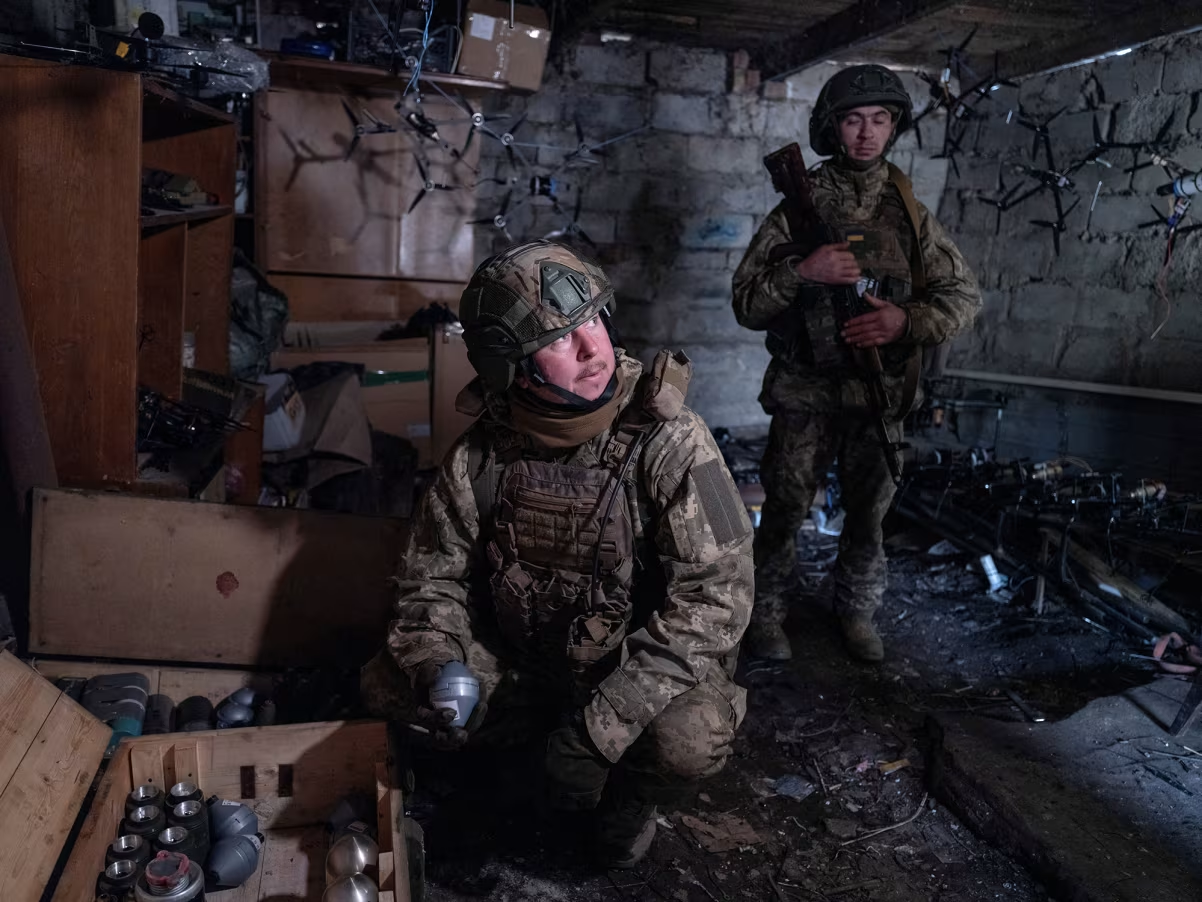
Iryna Rybakova/93rd Kholodnyi Yar Separate Mechanized Brigade/Reuters
Russia appears to be regaining battlefield momentum in Ukraine, according to new military assessments and Western intelligence analysis, signaling a potentially dangerous turning point in a war that has already stretched beyond two years with no clear political resolution in sight.
Recent reporting from CNN indicates that Russian forces have built what analysts describe as a “winning streak” across several sectors of the front line, capitalizing on manpower advantages, sustained artillery pressure, and Ukraine’s growing shortages of ammunition and troops. The developments come at a moment when Kyiv is struggling to stabilize defenses while awaiting additional Western military support.
Military experts say the shift is not defined by rapid territorial breakthroughs but by steady, grinding gains the kind of progress that slowly reshapes battlefield realities over months rather than days. Russian units have reportedly intensified coordinated assaults in eastern Ukraine, particularly in contested regions where Ukrainian defenses have been stretched thin after prolonged fighting.
Western officials cited in the analysis warned that Russia’s approach reflects a strategy of endurance rather than speed. Instead of dramatic offensives, Moscow appears focused on exhausting Ukrainian forces through constant pressure, forcing Kyiv into defensive withdrawals that gradually expand Russian control.
Ukrainian commanders, meanwhile, continue to rely heavily on drone warfare and precision strikes to offset Russia’s numerical superiority. Ukrainian long range attacks targeting logistics hubs and military infrastructure inside Russian controlled areas have demonstrated technological adaptability, but analysts caution that innovation alone may not compensate for shortages of ammunition and personnel.
The battlefield reality is increasingly shaped by logistics and industrial capacity. Russia has expanded domestic weapons production and secured external supply channels, allowing it to maintain sustained artillery bombardments. Western intelligence assessments suggest that Moscow’s ability to replenish equipment and rotate troops has improved compared with earlier stages of the war.
Political dynamics outside the battlefield are also influencing the conflict’s trajectory. Delays and debates over military aid among Western allies have created uncertainty for Ukrainian planners. Some officials fear that inconsistent support risks giving Russia strategic breathing room at a critical stage of the war.
At the same time, analysts emphasize that describing Russia as “winning” does not mean the conflict is nearing conclusion. The war remains highly fluid. Ukrainian forces still control significant territory, and neither side currently possesses the capability for a decisive knockout victory.
Security experts note that wars of attrition often hinge less on individual battles and more on long-term economic resilience, international alliances, and public endurance. Ukraine continues to receive diplomatic backing from Europe and North America, while Russia’s leadership portrays the conflict domestically as a prolonged struggle against Western influence.
The evolving situation has renewed concern among European governments that a prolonged stalemate could reshape regional security for years to come. NATO officials have repeatedly warned that the conflict’s outcome will influence future global conflicts, military doctrine, and geopolitical alignments far beyond Eastern Europe.
For civilians caught in the middle, however, the strategic calculations offer little immediate relief. Air strikes, displacement, and infrastructure damage continue to define daily life across large parts of Ukraine, underscoring that despite shifting battlefield momentum, the human cost of the war remains the most constant reality.
As fighting intensifies heading into another campaign season, military observers say the central question is no longer whether the war will continue but which side can sustain the longer fight.

Promise Idoko is Junior Reporter working with moderncrux He covers global politics and international affairs. Based in Nigeria,


